

Most of us say we are open to feedback, but are we really?
Hearing feedback may be one of the most challenging things we face in our day-to-day. We need feedback to improve, yet we can’t help but take it personally when we’ve poured our heart and soul into something and it doesn’t live up to expectations.
As a business leader, it’s up to you to set the tone for how feedback is delivered and received in your organization. This is something that requires coaching, practice, and a lot of empathy.
My Feedback Story
Like many high-achievers, I aimed for perfection and took feedback like Muhammad Ali took punches: leaning against the ropes waiting for my opponent to tire so I could find a way to win. I sought out feedback, but did so in a competitive way; to prove I could do better. As I became more involved in the startup space (and somewhat more mature) I began to see feedback as a way to poke holes in business ideas and strategies. It became a learning tool that could help me anticipate objections and perfect my pitch. Now, managing a team of seven, my perspective on feedback has evolved and I see it as a coaching, learning, and communication tool.
Why Make It Collaborative?
Feedback is hard. It’s hard to give and it’s even harder to receive. If we think about the goal of feedback, it boils down to improving on a situation, whether personally or professionally. When it becomes collaborative, the tone shifts from, “Let me tell you what you did wrong” to “How can we improve this”. Instead of leading with the negative, collaborative feedback puts your heart in the right place and helps the receiver understand that feedback is not meant to attack but to offer some form of personal or professional development.
How To Prime For Feedback
The thing that makes feedback strike a sensitive chord is that it’s usually fueled by emotion. To keep emotion at bay, start with the facts. Be as specific as possible so the person is able to remember exact references. For example, instead of saying, “you’ve been late to work a lot this month” try, “last week you were late on Monday and Wednesday. The week before you were late Wednesday and Thursday as well”. By focusing on facts, you remove the accusatory tone of “you’ve been late a lot” that carries notes of judgement and disapproval.
Follow Fact with Fiction
Once you’ve shared the facts around the situation, it’s important to also share your perspective. However, you want to do this assuming the best in the other person. Using the same example of an employee coming into work late, you might say, “I know you’re a conscientious person and you have always respected the organization policies about coming into work on time so I’m beginning to think there’s something else going on that’s causing you to be late so frequently”.
By taking this approach, you’ve showed the employee that it’s not ok to come in late but you believe them to be a good person and are willing to give them the benefit of the doubt.
Put The Ball Back in Their Court
Open up the conversation for them to respond, by simply asking a question; “What’s going on?”.
At this point, you’ve laid out the facts and shown that you’re giving them the benefit of the doubt. It’s time for them to talk. Their response may pour out of them or they may remain silent for a few uncomfortable moments. If they open up to you, you’ve successfully made the conversation collaborative and can then ask them what they intend on doing so they won’t be late again. Unfortunately, it’s not always that easy.
If the employee responds with silence or indifference, use phrases like “it seems like you don’t want to talk about this”. Alternatively, if they respond with anger or tears, reassure them that you want them to continue growing in the organization and don’t want something like tardiness to impact their ability to do so.
Get Collaborative
Questions beginning with, “what” and “how” are great to encourage collaboration. Once you have an understanding of what’s going on, you can then progress the conversation to focus on a resolution. In this case, it would be, “what will you do to ensure you’re not late again”.
Assuming you get an answer, be careful not to leave it there. Test the answer by reiterating it: “You’re saying that if you set your alarm clock for 30 minutes earlier, you’ll never be late again”. While this may trigger a laugh, they’ll likely balk at the word “never”. This is where you can get real and offer to check in on how it’s working for them. For example, “How about you try setting your alarm clock 30 minutes earlier for the next two weeks and check-in after that to ensure you’re on the right track”.
By setting a follow up conversation, you’re showing your intention to hold them accountable. Sometimes, all we need is to know someone will be checking in on us to motivate us toward success.
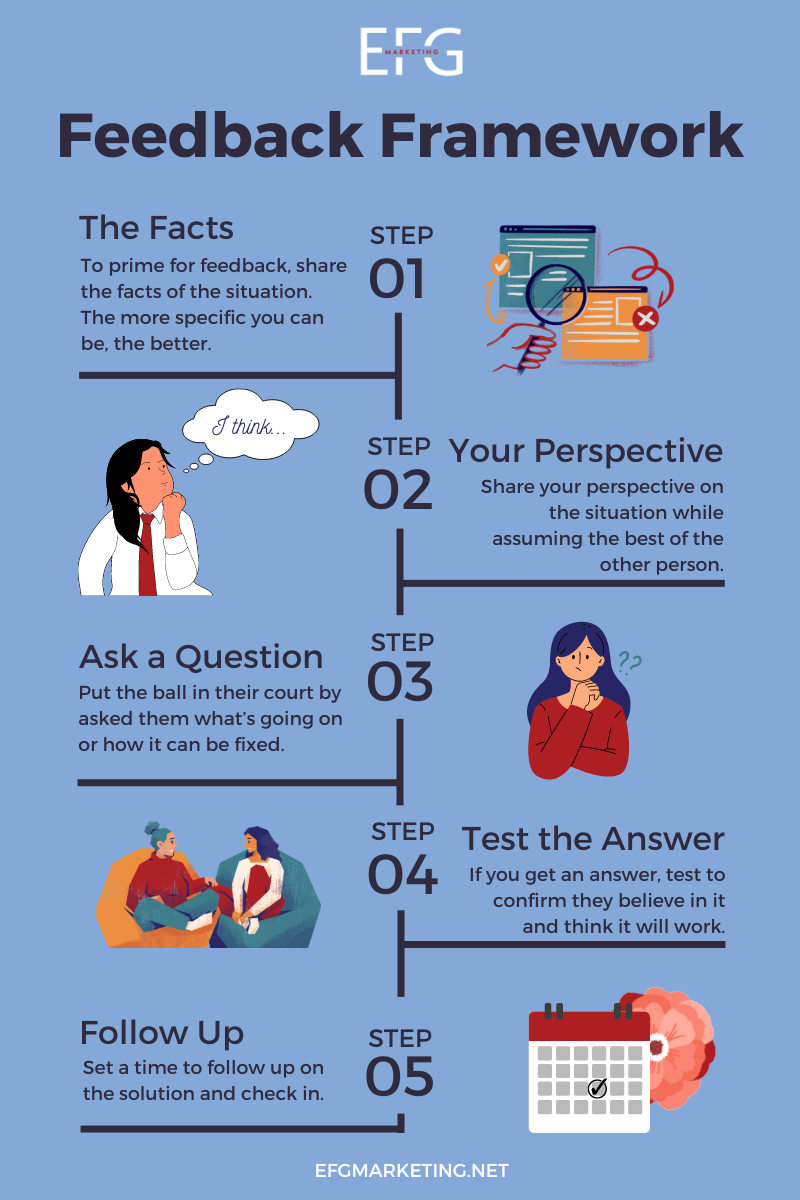
A Simple Feedback Framework
- Use facts to prime for feedback
- Share your perspective
- Asked them a question
- Test their answer
- Set a time to follow up
While this may seem overly simplified, sometimes simple is what you need. Every conversation will go differently, but if you’re grounded with a core framework, you’re setting yourself up to make every conversation productive.
Further Reading
Much of my training in having tough conversations with employees and the best ways to deliver feedback comes from the book, Crucial Conversations, by Joseph Grenny, Kerry Patterson, Ron McMillan, Al Switzler, and Emily Gregory. I recommend listening or reading a copy and following along with some of the exercises they take you through. In the book, they will introduce you to a communication framework called, STATE, a framework I use to prep for almost any tough conversation I have coming up.
 Supporting Business Leaders